THCA Shipping Restrictions by State Explained
A top-shelf jar is only a good deal if it can legally reach your doorstep. THCA shipping restrictions by state can change what is available to you at checkout, even when a product is federally compliant hemp and comes with third-party lab results. That is not a quality issue. It is the reality of a fast-moving legal landscape where federal definitions, state hemp rules, carrier standards, and local enforcement do not always line up.
For discerning customers, the smart move is simple: know what the law measures, verify your delivery address before you shop, and never assume a state with legal cannabis automatically allows hemp-derived THCA to be shipped there. Premium flower deserves a clear answer before it leaves the warehouse.
Why THCA Shipping Restrictions by State Change
THCA, or tetrahydrocannabinolic acid, is the naturally occurring cannabinoid found in fresh and properly cured cannabis flower. Before heat is applied, THCA is not delta-9 THC. Once flower is smoked, vaped, or otherwise heated, THCA converts into delta-9 THC. That conversion is why THCA flower delivers an experience familiar to cannabis consumers and why regulators look at it so closely.
At the federal level, hemp is generally defined by delta-9 THC concentration on a dry-weight basis. Products marketed as hemp-derived THCA are commonly formulated and tested to remain within that delta-9 threshold before decarboxylation. But federal hemp language is only one layer of the equation. Individual states can adopt stricter definitions, use different testing methods, regulate intoxicating hemp separately, or prohibit certain hemp-derived cannabinoid products outright.
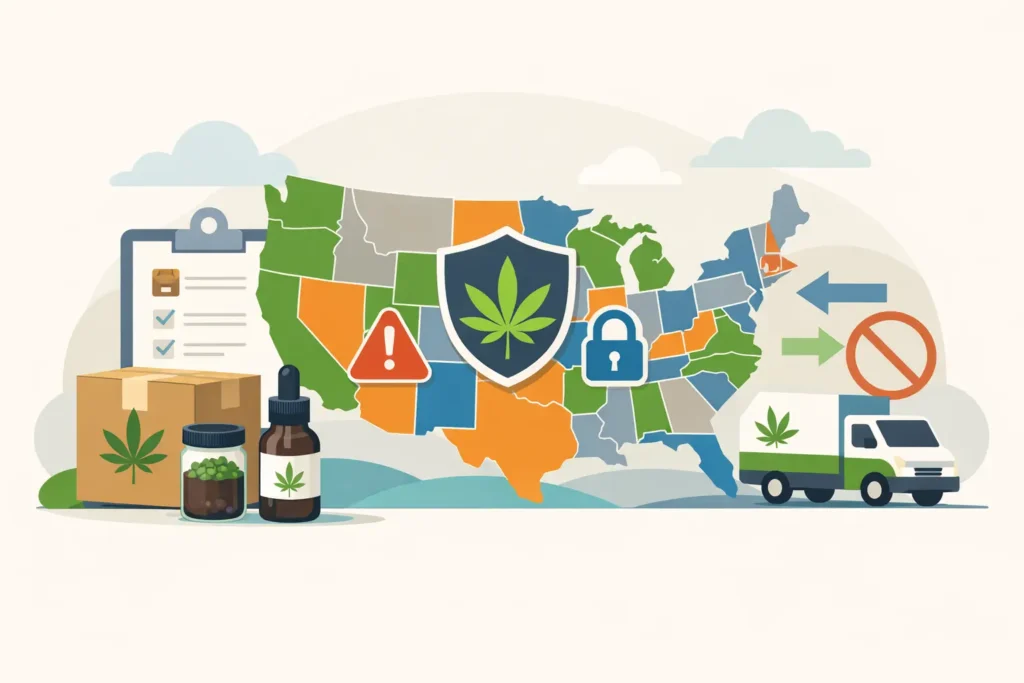
The result is a patchwork. A flower product may be eligible to ship to one address and restricted at an address across the state line. Laws can also shift through a new bill, emergency rule, agency guidance, or court decision. A list that was accurate last season can become stale fast.
The State Rules That Matter Most
When a retailer evaluates whether it can ship THCA flower, pre-rolls, or vapes to a customer, the question is not just whether hemp is legal in that state. The answer usually turns on several details working together.
Delta-9 testing versus total THC testing
Some states focus on the product’s actual delta-9 THC level, which tracks the federal hemp framework. Others use a total THC calculation. Total THC estimates the delta-9 THC that could exist after THCA is converted through heat. Since premium THCA flower can contain meaningful THCA content, it may exceed a total THC limit even if its pre-decarboxylation delta-9 result is within the federal hemp threshold.
This is one of the biggest reasons a product that looks compliant on a certificate of analysis may still be unavailable in a specific state. The COA matters, but the testing standard the destination state applies matters just as much.
State definitions of hemp and THC
States do not always use the same statutory language. Some define hemp narrowly. Some regulate products by their potential intoxicating effect. Others place limits on cannabinoid concentration, product format, or sales channels. A state may permit certain non-intoxicating hemp goods while taking a much harder line on THCA flower, high-THCA pre-rolls, or inhalable vapes.
That distinction matters for customers who see hemp gummies, CBD tinctures, or low-dose products widely available nearby. Those products do not automatically prove that THCA flower can be mailed into the same state.
Adult-use cannabis does not equal mail-order eligibility
Legal recreational cannabis can create a false sense of certainty. State-licensed cannabis programs generally operate inside state borders, with licensed cultivation, testing, distribution, and retail systems. They do not create permission for cannabis or hemp-derived intoxicating products to move through interstate commerce.
So even if your state has dispensaries, a direct-to-consumer hemp retailer may still restrict delivery there. Likewise, a state without adult-use cannabis may allow some federally compliant hemp products. Shipping eligibility depends on the specific hemp rules, not a simple legal-versus-illegal cannabis label.
Local rules, carrier policies, and age requirements
State law is not the only checkpoint. Cities, counties, carriers, and payment partners may impose their own limits. Retailers also need to enforce age gates and prevent shipment to addresses where a product is restricted. For adult customers 21 and over, that can feel inconvenient, but it protects the supply chain and helps keep compliant products available where they are permitted.
How to Check Whether THCA Can Ship to Your Address
The most reliable answer comes at the point of purchase. Enter your complete shipping address accurately, including apartment or unit information, and let the retailer’s compliance system evaluate the destination. Do not substitute a friend’s address, use a freight forwarder, or attempt to reroute a restricted order. Those workarounds can lead to cancellation, return, loss of product, or worse.
Before ordering, look for three signs that a retailer takes compliance seriously: clear age requirements, destination-based shipping controls, and current third-party lab documentation. A trustworthy COA should identify the product, show cannabinoid results, and make it possible to confirm the lot you are buying. For flower, potency alone is not the whole story. Clean testing and transparent handling are part of the premium standard.
If checkout blocks your address, treat that as a compliance safeguard, not a challenge to overcome. Restrictions can be based on state legislation, agency interpretation, or a retailer’s risk policy. Retailers may choose to be more conservative than the bare minimum legal standard when the rules are unclear. That caution is often what keeps operations consistent and discreet for customers in eligible states.
What This Means for Flower, Pre-Rolls, and Vapes
Product format can change the risk profile. THCA flower and pre-rolls are often examined through the same testing and hemp-definition questions, though some jurisdictions regulate smokable hemp more strictly than other product categories. Vapes may face additional restrictions involving inhalable products, flavored vapor rules, age verification, or device-specific regulations.
Do not assume that an eligible flower order means every item in the catalog can ship to you. The cleanest approach is to build your cart, confirm the destination, and review checkout notices before payment. If a product is removed or unavailable, it is usually tied to the shipping address or product category rather than your account.
For repeat buyers, this is worth checking again when you move, send a gift, order from a different device, or return after a few months away. Hemp policy is active territory. A state that was open to a category earlier in the year may update its rules, and a retailer may adjust its shipping map immediately to stay compliant.
Avoid the Most Common THCA Shipping Mistakes
The first mistake is treating a product label as a complete legal opinion. Terms like hemp-derived, Farm Bill compliant, or under 0.3% delta-9 THC describe meaningful product characteristics, but they do not override destination-state law. Read them as part of the picture, not the whole picture.
The second is confusing possession rules with shipping rules. You may see a product sold locally, hear that friends have used it, or find similar flower at a smoke shop. None of that confirms that a direct-to-consumer shipment is permitted to your address. Retail sales, delivery, possession, and interstate shipping can be governed differently.
The third is ignoring policy updates. A retailer cannot promise shipment where the law or internal compliance policy says no. Seigler’s uses destination-based controls so eligible customers can shop hand-curated, lab-tested hemp-derived THCA with more confidence, while restricted orders are stopped before they create a problem.
A Better Way to Shop Premium THCA
Start with the product standards you expect: current lab results, clear cannabinoid information, properly handled flower, and a retailer that does not blur legal lines to force a sale. Then confirm availability for your exact destination before you fall in love with a strain. That order matters.
If your address is eligible, you can focus on what should drive the purchase: terpene profile, flower quality, format, potency, and value. If it is not eligible, respect the restriction and check back only after your state’s rules or the retailer’s policy changes. Premium means being selective, and that includes being selective about where a product can legally go.
The best order is not the one that merely gets placed. It is the one that is legal, verified, and ready to arrive discreetly at the right doorstep.